
On August Reading
My literary endeavours from the past month

“I am longing to be with you, and by the sea, where we can talk together freely and build our castles in the air.” Bram Stoker, Dracula
Hello again. I wasn’t really sure what to write this week. It’s difficult in that I don’t want to force myself to write these small updates, but I’d also like to try and maintain some form of consistency, which I’ve chosen to do through a weekly post. As such, I settled on a quick run through of the books I’ve read this past month! Sidenote - I didn’t read many, and all three were rereads as I venture into the final week of writing my dissertation. Let’s get into them, shall we?
I read three books in August, all of them vampiric, all of them relevant to my dissertation. For an extremely rough outline (I’m still redrafting the final project right now), my research attempts to draw out key traits of traditional female vampires and observe how they are adapted and utilised in contemporary literature. It is rather difficult to credit concrete agency to eighteenth and nineteenth-century female vampires, after all, since a lot of them unfortunately end up staked. Nevertheless, I believe that reading these texts through an alternate lens opens up new avenues of possibility, avenues that do not alter their own fates but that become incorporated into later texts to restructure the female vampire in an empowering, agential manner. There. My dissertation is in its essence. With this outlined, here are the books that I read and my thoughts on them!
The three books I read were:
An Education in Malice, by S.T. Gibson
Interview with the Vampire, by Anne Rice
Dracula, by Bram Stoker
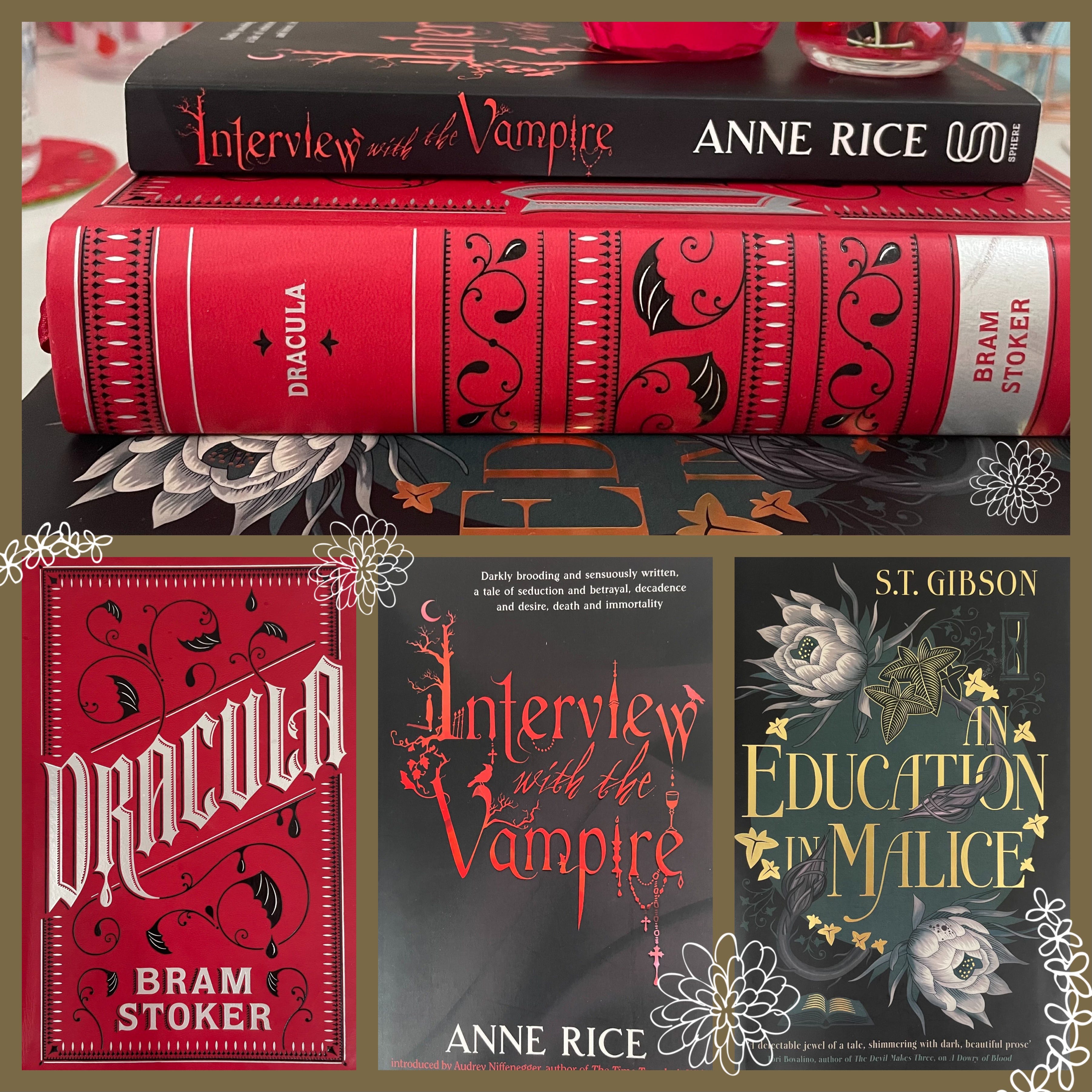
As my project begins in the nineteenth century and progresses toward the twenty-first, you may be able to glean from this list that I actually wrote my project backwards. S.T. Gibson’s novel was the inspiration for my project, and so understanding what my ultimate argument was became integral for me to figure out before returning to previous literary traditions. For the sake of this post, however, I will review the texts chronologically, and so we begin with Dracula.
As I’ve already mentioned, none of these are new texts for me, and Dracula is one of my favourite reads. I make a habit of rereading the book and rewatching the film (1992) every Halloween, and intend to continue the tradition this year! Generally, I don’t have a focus in mind when rereading, but for the sake of this dissertation, my primary interest was Stoker’s portrayal of Lucy Westenra. Lucy is one of my favourite female vampires of all time, which is rather unfortunate given that, in the text, her vampirism is not necessarily prevalent for much of the story. Stoker’s novel is very much one that talks a great deal about vampires, but saves the actual confrontation with them to short segments scattered about the narrative. Of these, the most notable scenes for Lucy are her feeding from children and her death. Not a whole lot for three hundred pages! Nevertheless, what specifically interested me about Lucy was both her existence in a text concerned with notions of Victorian femininity and also her underlying defiance of such ideology.
On the surface, Lucy Westenra is the picture of docility, domesticity, and delight. She is to be married, is overjoyed about this fact, and is unfortunately vampirised and killed before this happiness occurs. And yet, this remains surface-level. In letters to Mina Harker, Lucy laments the difficulty of her decisions, jests about marrying multiple suitors, and considers how she would propose were gender roles in the novel reversed. Lucy very much rejects the notion of the Angel in the Home textually, whilst simultaneously maintaining it physically. This is what makes Lucy such a fascinating vampire to me, because much of her controversy is identifiable long before she truly becomes a vampire. Consequently, it is not necessarily the vampire that is framed as evil in Stoker’s novel, but the nonconformative woman that can maintain this dual visage right up until her final moments. Lucy offers many routes of interpretation if one gives up a generalised reading of the text in favour of a more abstract approach, and this is why she opens my discussion of female vampirism!
“Claudia was my dark child, my love, evil of my evil.” Anne Rice, The Vampire Lestat
The second book that I read was Anne Rice’s Interview with the Vampire, and my focus was, predictably, Claudia. If Lucy Westenra’s vampirism was a manifestation of the New Woman challenging Victorian female ideology, Claudia’s vampirism is an infantile physical savagery that challenges even Lestat, the arguable apex predator of the text. Transformed into a vampire at the age of five, Claudia grows mentally while retaining the shape of a small child. She is doll-like in appearance, and utilises this to lure in victims, making a game of the hunt before draining them. Unlike Lucy, whose actual predatory vampirism is rather clumsy, Claudia is a vampire modelled in Lestat’s likeness. In fact, the technique with which she hunts is the problem, because Claudia is more capable than both of her fathers. She is restricted only by her size, which imposes not only a physical hindrance, but a financial and administrative dependence. Claudia does not let this phase her, however, and after killing Lestat and establishing herself as the text’s primary vampire, she demands that Louis create her a mother.
The vampirification of Madeleine is both what renders Claudia significant and warrants her demise. Claudia’s appearance invokes uncertainty and confusion: characters are never comfortable treating her as the woman she is. Madeleine, however, idolises Claudia. As a doll-maker, she is both literally and metaphorically perfect for this vampire child-woman, and Madeleine makes Claudia her whole world. She crafts an entire living space modelled to Claudia’s small size in their hotel room, and, in a sense, gives Claudia an entire world in which she has dominion. Such agency has never been granted to a female vampire before, and this idea was of great significance to my thinking process. Of course, like her predecessors, Claudia is restricted by the time period in which she was written. Much like the New Woman posed a problem in the Victorian era, a child-woman who kills with delight whilst maintaining an innocent, angelic visage was not tolerable, especially considering that the narrative itself is concerned with Louis’ gradual loss of humanity. Claudia was never granted space to be centre stage, and so, at the height of her vampirism, she is punished for her transgressions, burnt in sunlight whilst entwined with Madeleine. This imagery felt to me a continuation of Lucy’s underlying textual defiance, for Madeleine and Claudia remain joined at the narrative’s end, a feeble imitation of a coven, yes, but a representation of what could become the future of vampire texts: vampiric matriarchy.
“It should always be like this. It should always be senior year. I should always be twenty-one, with nothing but life ahead of me. It should always be sunrise, at the start of a new day.” S.T. Gibson, An Education in Malice
Finally, then, we have Gibson’s An Education in Malice. I love this novel. It takes Sheridan Le Fanu’s Carmilla as its centre and increases the sapphic nature, increases the vampire population, and renders its narrative almost wholly matriarchal. Furthermore, Gibson renames the original Laura, utilising her maker’s surname: Sheridan. I won’t go into great depth about this one because I actually reviewed it over on The Macabre Magazine, but Gibson, as a writer, picks up on the textual, abstract notions of female power that I’ve identified through my rereading, and utilises them to bolster the agency of protagonists. As a result, neither Carmilla nor Laura Sheridan die at the end of this novel. If Lucy’s demise constitutes her main story in Dracula, with her subversive nature restricted to letters, then Gibson inverts this with the destruction of the original Carmilla tale, carving out space for her newer, modern protagonists to reforge their story in an agential manner.
This actually took a little longer to type out than I initially thought! Apologies, as it will now be published late. I am glad I took the time to share these books, though. They are by no means niche, hidden titles in any way, but I hope that I’ve offered a new lens through which to read them, should you reach for them again anytime soon!
Lx
Lois this was so interesting to read you have to let me read your diss when you're done!